
September 30, 2026
Guest post by Allie Middleton
Five years ago, during the uncertainty of the COVID-19 pandemic, the Mohawk Hudson Land Conservancy published my guest essay, Nature & Well-Being. https://www.mohawkhudson.org/blog-posts/nature-and-well-being-a-guest-post-by-allie-middleton
During those months of isolation, many of us rediscovered what these conserved lands quietly offer: places to breathe, to walk, to restore our spirits, and toremember that our own well-being and sense of belonging is inseparable from thewell-being of the natural world.
Much has changed since then.
Our communities have reopened and evolved. We have found new ways of gathering, learning, and caring for one another. Yet the invitation offered by these lands remains remarkably constant.
Today,as the Mohawk Hudson Land Conservancy enters a new chapter—developing a new strategic plan, expanding community partnerships, and embracing new opportunities through creativity and the arts—it feels like the right moment topause and ask a different question.
What can we learn by listening?
Over the past several months, volunteers, educators, conservation leaders, and MHLC community members participated in a series of Listening from the Land conversations. Rather than documenting accomplishments, these dialogues explored somethingmore fundamental.
How do people come to know a place?
The answers were wonderfully diverse.
For one volunteer, everything began with a trail.
“It was the existence of the Rail Trail… that made it a very, very easy decision to decide tolive where we now live.”
Another remembered how the trails became a refuge during the uncertainty of the pandemic.
“Walking on the trails… became a refuge.”
For a newer volunteer, that refuge deepened into something closer to a resonance with reverence.
“I felt this incredible sense of peace being in the woods.”
Others spoke about returning again and again, not because the landscape stayed the same, but because it was always changing.
“We always look to see what’s changing.”
For that same couple, the woods offered something different depending on who was looking.
“The peace and quiet of the woods… that’s what I look for and appreciate seeing.”
“For me, it’s the color… the leaves, the plants, everything.”
For one, that same instinct shaped how he chose to steward, rather than simplypatrol, the land he cared for.
“I wanted to be more supportive of what people wanted to do, whatever that was.”
These are more than memories.
They are stories of relationships, of care.
Again and again, volunteer stewards described how their understanding of these places had been expanded through one another.
“My experience of the trail has been enriched indirectly through the perspectives of other people.”
A conversation about berries became an opportunity to distinguish blackberries from black raspberries.
“If somebody says the blackberries were out, I might say, were they blackberries or black raspberries?”
A sighting of a tiny wildflower became an introduction to the Deptford Pink variety of dianthus.
“I thought, let me take a picture of it, and let me look it up… My experience of the trail has been extended a little bit because I take an interest in this.”
For another, the surprise came from something considerably larger than a flower.
“You’re riding along and you see this old tree looking at you like some prehistoric creature… wow, what a place you get to be close to and know.”
For a longtime hike leader, the reciprocity of it all ran in both directions.
“Getting to see the woods through the eyes of the people is a real treat.”
Birdsong became shared curiosity.
Knowledge moved quietly between people.
Listening became learning.
Learning became stewardship.
The conversations revealed that there aremany ways of knowing a landscape.
Some people come through science.
Others through history.
“I’m listening to the wind… listening to the history… living such peaceful times.”
Some through photography.
Others through gardening, birding, painting, cycling, volunteering, or simply returning to the same trail throughout the changing seasons:
Children discover these places through wonder.
Families through traditions.
Artists through imagination.
Long-time residents through memory.
Newcomers through discovery.
Some found the land connects across differences as much as it connects across seasons.
“Even though our own community is not extremely diverse, I’m always gratified that it’s somewhere people from diverse backgrounds feel safe to go.”
Othersnoticed the way one preserve leads to the next, each with its own boundary,each part of something larger.
“Each preserve has a boundary, and then ten kilometers over there, there’s another preserve with another boundary. I love it!”
As one volunteer reflected, our community enjoying these lands continues to grow and evolve. Thoughtful improvements—including paved trail surfaces, welcoming trailheads and informative kiosks, and accessible parking—have enabled manymore people to experience the beauty and health of these places. Different communities continue to find their own pathways into nature, discovering not only convenience and accessibility, but also a sense of belonging.
“… (after the rail trail was paved.) There were people right away, in wheelchairs, with walkers—all kinds of people who hadn’t used the trail otherwise were now using it.”
For one volunteer, the value of that closeness was something felt in the body.
“You’re never very far from nature here… it’s just a short bike ride away.”
For another, accessibility meant something broader still.
“The bike path shouldn’t be just accessible to people who live in the nicest neighborhoods. It should be accessible for everyone.”
Accessibility, in this sense, is another expression of stewardship.
It quietly says:
There is a place for you here.
One volunteer reflected on the remarkable network that has emerged across ourregion.
“People in general are increasingly aware… From the Rail Trail, I can get to there. From there, I can get to here… What a fantastic place this is to live because we have all of this.”
Anothe rput it more simply still...
“It’s a place people take tremendous care of… and care of each other.”
That observation reaches beyond trails.
It speaks to a living network of relationships connecting forests, farms, rivers, neighborhoods, preserves, and people throughout the Mohawk and Hudson River Valleys.
At the confluence of these two great rivers, separate waters meet while each retains its own character.
The Listening Conversations suggest another kind of confluence:
Science and art.
History and possibility.
Volunteerism and stewardship.
Personal stories and collective memory.
Many voices flowing together intosomething larger than any one of us.
Throughout these conversations, Brazilian artist and researcher Geisa Paganini De Mio listened in another language.
Her generative scribing image does not simply illustrate the conversations. The process of visual presencing listens alongside, helping to make a systemvisible, revealing patterns of relationship, curiosity, generosity, movement,and expanding connections that often emerge before we have words for them.
Her work reminds us that listening itself is a creative act.
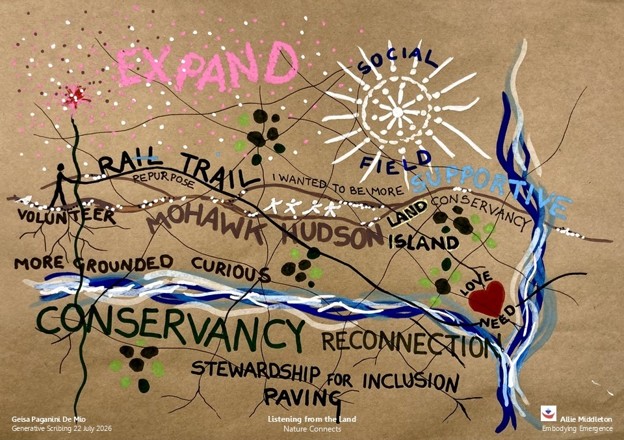
Together, conversation and image invite us to know MHLC not only as a protector of land, but rather as a convener of heart based relationships—between people and place,between generations, between imagination and stewardship for the sake of our shared future.
Throughout these conversations another pattern quietly emerged:
An evolving ecology of communication.
Listening was not confined to words.
People listened through their bodies asthey walked the trails.
They listened to changing seasons.
To birds and wildflowers.
To rivers and streams.
To silence.
To longtime volunteers.
To newcomers seeing familiar places with fresh eyes.
They listened through science.
Through art.
Through stewardship.
Through shared experience.
Each form of listening enriched theothers.
Together they cultivated shared understanding, shared responsibility, and an ever-deepening capacity to care.
Perhaps this is one expression of an ecological intelligence—the growing awareness that healthy communities arise through healthy relationships: among people, among places, and between people and the living systems that sustain them.
As the Mohawk Hudson Land Conservancy looks toward the future, these Listening from the Land dialogues offer quiet guidance.
They remind us that conservation has always been about more than protecting land.
It is about cultivating relationships.Connecting people to Nature and more:
Relationships with forests and fields.
With rivers and wetlands. Wind and water.
With neighbors and volunteers.
With artists and scientists.
With children discovering wonder for thefirst time.
With those who cared for these placesbefore us.
And with those who will inherit them afterus.
For one volunteer, the fitting close was not a summary but an image of the web still growing.
“Let’s expand the access, expand the interconnection… so that we can go out of our front door and we can explore.”
Robert Frost, in Two Tramps in Mud Time, offered words that seem especially fitting:
“Only where love and need are one…”
Perhaps this is what the volunteers have been teaching us all along.
When love for a place and the need to care for it become one, stewardship ceases tobe simply something we do.
It becomes a way of belonging.
At the confluence of the Mohawk and Hudson Rivers, waters meet without losing themselves.
Perhaps communities grow in much the same way:
By listening deeply.
By welcoming many voices.
By sharing our care for one another andfor the land.
And by discovering that, together, we are participating in an evolving ecology of communication that will continue to shape the future of this remarkable bioregion for generations to come.
Listening from the Land is an ongoing collaboration of Allie Middleton and Brazilian artist andresearcher Geisa Paganini DeMio. Through generative dialogue and simultaneous scribing, the Embodying Emergence project explores how relationships with space and place shape awareness, stewardship, creativity,and community action across the Mohawk and Hudson River bioregion and beyond.


